

Multilingualism, Power and Decolonial Struggle in South Africa

Dr. Mobina Sahraee Juybari speaks with Prof. Kathleen Heugh (Adelaide University, South Australia) about "Language planning from below" in South Africa. Drawing on a wealth of experience, Kathleen provides rich and deep insight into pre and post-apartheid language policy. This is the first of a series of entries documenting an ongoing conversation with Kathleen.
Mobina: I would like to begin with your early work on National Language Project and South Africa’s transition from apartheid to democracy. Looking back, how did those experiences shape the way you understand the relationship between language education, power and social change today? I am also wondering how this relates to your understanding of postcolonial and decolonial debates and theory.
Kathleen: My understanding of the connections among language education, power and the contextual as well as theoretical differences between postcolonial and decolonial approaches to social transformation began before I joined the National Language Project (NLP) in South Africa. African students had been rebelling against apartheid education since the late 1970s. I realised that apartheid, a particular form of colonialism, adopted as a political framework between 1948 and 1994, was anchored in language policy and ethnolinguistically separated education, intended for social division and inequality.
It occurred to me that in anticipating the end of apartheid, there would be lessons to learn from postcolonial language education policies elsewhere in Africa. So, while teaching English in a secondary school, I enrolled in a Master of Philosophy at the University of Cape Town in the early 1980s. This was a difficult time to undertake research with the purpose of prefiguring post-apartheid policy. Civil unrest precipitated by the education crisis in 1976, escalated during the 1980s, and was countered by the most repressive and restrictive deployment of power, including intimidation and violence.

An academic boycott of South Africa had followed the imprisonment of leaders of several influential resistance movements in the 1960s and the banning of their organisations. This drove many political dissidents into exile. The academic boycott prevented access to postcolonial policies adopted in African countries after independence in the 1960s. The apartheid government also made it difficult to access any academic literature that might be critical of the regime, or that might offer democratic alternatives. In effect, government was fearful that postcolonial examples from elsewhere in Africa would incite rebellion. Any literature that was available, especially literature that was considered anti-colonial, ‘liberatory’ or sympathetic to socialism, for example from Eastern Europe, was banned in South Africa.
In 1910, an official bilingual Afrikaans (formerly Dutch)-English policy had followed the establishment of a Union of South Africa and nine African languages were also eventually recognized, albeit with diminished status. Almost immediately, African leaders of political resistance, in 1912, identified English as the eventual language of liberation for the country. During 46 years of apartheid rule, 1948-1994, Afrikaans came to be regarded as the ‘language of the oppressor’ and it was African students’ rebellion against the imposition of Afrikaans medium education in secondary school that sparked the education crisis in 1976. The resistance movements, the African National Congress (ANC), the Pan Africanist Congress (PAC) and the Black Consciousness Movement (BCM), had external bases in Africa, Europe and the Soviet Union, anticipating eventual change of power. I assumed that they would be working on policies, including language, for the eventual end of apartheid.
Mobina: So how did you approach researching language policy and finding out what the resistance movements were thinking about language policy?
Kathleen: While I was able to source early literature on language policy and planning, including the work of Joshua Fishman, Einar Haugen, John Gumperz and Charles Ferguson, there was little literature available in South African university libraries that related to African countries after they achieved independence. One could only access outdated literature of Africa and / or liberatory movements elsewhere through the university’s ‘banned bookroom’. This required seeking written permission from state security to read a text, and if granted, one had to submit to being fingerprinted photographed each time one entered this part of the library. One could not withdraw or photocopy any of the materials held there. By virtue of entering the room, one risked drawing attention to one’s research and effectively inviting security raids on one’s home or place of work. Once I exhausted relevant materials in the banned bookroom, I resorted to covert and lengthy ways to source material from exiles abroad. It took anywhere from six to eighteen months between sending a request and receiving documents.
Since I was under constant surveillance, regular security raids on my home meant that this information was inevitably discovered and removed while I was out, teaching in a school. On the one hand, this was frightening and intimidating. On the other hand, it underscored the significance which the regime attached to language policy in education.
The material I was able to access from former British colonies showed remarkably similar patterns of postcolonial policy implementation. During the colonial years, Britain had encouraged local African language medium of instruction for four to six years in primary schools with transition to English medium in secondary school in several colonies. Missionary linguists assisted in the reduction of spoken languages to written text in a few widely spoken languages (or language clusters). This was primarily for evangelical purposes, but also for use in primary readers. It was consistent with recommendations from multiple education commissions in East and West Africa through the 20th century, including UNESCO’s 1953 Report on the Use of Vernacular Languages in Education.

Upon independence, almost all former colonies of France adopted French-only language education policies. Former British colonies followed with English-only. Tanzania and Kenya adopted an East African lingua franca, Kiswahili, as an official language alongside English, but education mostly defaulted to English-only from primary school in Kenya, and in secondary education in Tanzania. Despite the advice of international education commissions and UNESCO’s Report, the British Council and several UK-owned textbook publishers encouraged the adoption of the English-mainly policies after independence. This hinged on a two-pronged argument: (i) a single neutral language (English) would promote national unity, and (ii) the production of textbooks in multiple African languages was not considered
to be economically viable.
Educational linguists and speakers of African languages knew that evaluations of the early primary reading programme in English, New Peak, had failed students in Kenya. They noted that despite failure in Kenya, New Peak soon found its way to Zambia, and despite adaptations, had similarly dismal results there. The programmes did not bring literacy in English (nor did French elsewhere) to most African language speaking students. Growing dissent among African scholars and some politicians drew attention to contradictions between postcolonial political aspirations and inevitable default to neocolonial policies and practices. Substantial debts were racked up for system-wide use of textbooks in English (or French in West Africa) and programmatic failure. Political control during colonization was thus exchanged for economic dependence on Britain and France.
In the case of former British colonies, publishers argued that the problem lay with the teachers, ex-patriate (ex-pat) teachers came from Britain to teach and train local teachers. Host countries were to cover salary, travel and accommodation costs of the ex-pat teachers. After two-year contracts, before their lack of success with New Peak or other English-reading programmes became obvious, they were repatriated. They had neither transferred expertise, nor prevented widespread failure and attrition from primary schools. Debt escalated.
It was not unexpected that postcolonial governments would favour the former colonial language. So, it was a shock to discover that African scholars in Nigeria, Tanzania, Kenya and Zambia were revealing the failure of English literacy, and English medium of instruction (EMI) programmes. Like so many others, I had been convinced that English, taught well, would deliver equal access, retention and successful completion of schooling. I had assumed that EMI, at least by secondary school, would be appropriate for South Africa. Instead, it became clear that aspirations linked to English-only or English-mainly education were unrealistic and not delivering social transformation. After scouring documents from each of the resistance movements, I found language policy mentioned only in one, a conference report of the Azanian Peoples’ Organisation (AZAPO). Future language policy for South Africa was proposed at the AZAPO annual conference in 1985 by Neville Alexander. He viewed English as the future ‘linking language’ or lingua franca for Azania (AZAPO’s name for South Africa). Like so many, Alexander assumed that English would facilitate national unity. (My thesis would conclude with a recommendation that future policy should not follow this course.)
Mobina: Can you tell us a bit about Neville Alexander and his role as well as African scholars elsewhere in Africa during this period?
Kathleen: Alexander had established a radical body, the National Liberation Front, and been imprisoned alongside Nelson Mandela for a decade. Subsequently, by the 1980s he was linked to the BCM, the Azanian People’s organization (AZAPO), and the radical Cape Action League. In late 1986 he established several community-based organisations (CBOs), one of which was the National English Language Project to begin the process of popularizing English as the future ‘linking language’. During an interview with Alexander prior to completing my thesis, I drew his attention to the failures of English-mainly policies elsewhere in Africa, and newly published work of Ngũgĩ wa Thiong’o in Kenya, Decolonising the Mind: the Politics of Language in African Literature (1986) that was not yet available in South Africa. The University of Cape Town subsequently appointed Alexander as one of my examiners. I thought this was because my supervisor, a strong advocate for the English language, hoped Alexander would offer a strong critique.
Surprisingly, Alexander offered me the role of co-ordinator of the National English Language Project (NELP). I hesitated until the project’s name and focus on English changed. I joined Pamela Maseko (formerly Mankomo) in the National Language Project (NLP) in early 1988. The project expanded swiftly, bringing together people from different language backgrounds and expertise in literacy, bilingual education, interpreting, translation and working with trade unions and community organisations.
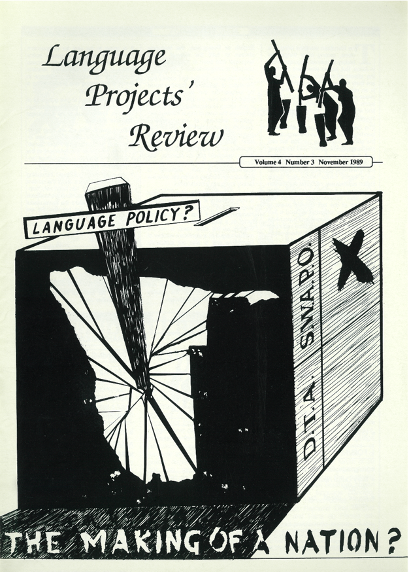
One of our responsibilities was to produce a quarterly publication, the Language Projects’ Review, which we renamed Bua! in 1994. Drawing on research from elsewhere in Africa and India, we disseminated information about non-government and community literacy and language projects, including bilingual and multilingual education.
I was also able to spend part of 1988 completing a course on teaching English as a second language at Iowa State University. That opportunity made it possible for me to photocopy journal articles and books relating to ‘postcolonial’ (in reality, neocolonial) language policies in Africa and to bring them back to South Africa while the academic boycott was still in place.
West African scholars, like Ayọ̀ Bámgbóṣé from Nigeria and Beban Chumbow from Cameroon, in a 1987 issue of the Journal of West African Languages and elsewhere Casmir Rubagumya from Tanzania analysed why top-down government-led, English, French, or Portuguese medium instruction policies did not work in Africa. The Six-Year Primary Project (1970-1976) in Nigeria, reported by Babs Fafunwa, Ayọ̀ Bámgbóṣé and others, demonstrated that it took six years of Yoruba medium education plus six years of learning English as an additional language for students to be able to transition to EMI in secondary school successfully. Whereas most schools in former British colonies attempted English medium from the first, second or third year of primary, the gap between English literacy programmes and reading to learn through EMI in fewer than six years was too great [Later verified in other African countries, e.g., Alidou et al., 2006]. Bámgbóṣé and Chumbow also argued that one-size fits all, top-down (government) policies, were unsuitable for diverse African communities. Alexander used their research as a rationale for ‘language planning from below’ and referred to the circulation of this research as ‘vanguard’ policy and planning.
Mobina: I’m interested in how the NLP was disseminating information about democratic approaches to language planning during last years of apartheid and preparations for political and social transformation.
Kathleen: Through the Language Projects’ Review and later Bua! between 1988 and 1996 we circulated research, policy, planning and implementation information as widely as possible. Initially we were concerned mostly with anti-apartheid groupings as well as universities and trade unions through the terminal years of apartheid. Once political negotiations for a new dispensation began, we drew attention to the mechanisms through which postcolonial policies succumbed to neocolonial interests and pressures. These served to reproduce colonialism long past its sell-by date. Although Alexander had no hands-on role in the NLP, many staff held more radical views than those of more centrist ANC-aligned perspectives. Ngũgĩ wa Thiong’o’s visit to the NLP in the early 1990s was an important moment in our discussions of decolonising debates and the role of African languages in the unshackling of colonial chains of oppression. Collectively, from the NLP and later from a sister NGO, the Project for the Study of Alternative Education (PRAESA) based at the University of Cape Town, we sought ways to democratise and decolonise language policy.

This involved elevating the status of African languages and recognising the functional daily use of specific languages, varieties or registers in people’s multilingual repertoires. Often people mix their languages to achieve conviviality, for example for informal communication in public transport and markets. At other times, a specific language or register is used for religious purposes, legal documents, academic journals. Front and centre were African languages, the functions they served or needed to serve in education, health and other social services. We referred to this as ‘functional multilingualism’.
Mobina: Thank you, Kathleen. It has been fascinating to hear this history and the story you have shared. This gives us insight into an emerging distinction between postcolonial and anti-/or decolonial approaches to language policy. Can you give us more insights on policy development and implementation and what those experiences taught you about the possibilities and limitations of translating multilingual principles into educational policy and practice?
Kathleen: Once the South African resistance movements were unbanned and political prisoners released in 1990, and constitutional negotiations were underway in South Africa, the NLP began developing policy proposals for multilingualism in the new Constitution. Almost immediately, however, we recognised that English-speaking South Africans, returning from exile in Lusaka, would be keen to champion English as the language of liberation. It had been under their watch that Zambia adopted and extended an English-only education policy, on the basis that a single language, with no links to any Zambian ethnolinguistic group, could support national unity from 1966 onwards.
Despite attempts to reintroduce local languages in 1977 and again in the 1990s, the English-only policy prevailed. Solid evidence from Zambian scholars, including Kathleen Siatchitema and Prayag Tripathi, supporting local language instruction was ignored. More troublingly, the English lobby in Zambia influenced exiled political movements from Namibia and South Africa. First, the United Nations Institute for Namibia (UNIN), based in Lusaka in Zambia, replicated the Zambian English-only policy for an independent Namibia. This was even though Namibia had never fallen under British rule and fewer than one per cent of Namibians were able to speak or understand English at independence in 1990. The English-only policy in Zambia and for Namibia cemented the resolve of Lusaka-based ANC exiles for future language policy in South Africa.

The Language Projects’ Review
disseminated the Nigerian and Zambian research data, and cautioned the ill-advisedness of increasing pressure for English-only policies in both Namibia and South Africa. The NLP started planning to host a conference on democratic approaches to language planning in 1991. For the first time since the onset of apartheid, scholars from across the continent and India were able to participate along with representatives from all South African political groupings. Kenyan, Tanzanian, and Zimbabwean scholars raised issues of competing and problematic orthographic systems, a legacy of the colonial partition of Africa and different systems used by English, French, German and Swiss missionary linguists.
Alexander proposed democratic approaches to harmonisation and standardisation of orthographies for scaling up African language textbook publication. Agnihotri, from India introduced the idea of flexible multilingual classroom pedagogies that could be implemented without waiting for state intervention, and this term was adopted in the NLP and PRAESA in their work and publications from 1992 onwards. We also proposed the establishment of an independent African Languages Board or Institution to guide language planning.
We lobbied every political party involved in discussions about South Africa’s constitutional future and the negotiated settlement that would lead to the 1994 election. When the Constitution was finalised in 1996, it provided for a statutory body known as the Pan South African Language Board to oversee constitutional provisions to promote and protect multilingualism in the country, and official status was given to eleven languages. Nine African languages: isiXhosa, isiZulu, SiSwati, isiNdebele, Sesotho. Setswana, Sesotho sa Lebowa, Tshivenda, Xitsonga; alongside Afrikaans and English). One of our proposals, a consultative democratic national language plan, was finalised by early 1996. However, a clearly defined language policy had not yet been articulated. Without this, some government departments implemented language policies that did not align with the constitution. This was the case for education.
Returning exiles from Zambia, party to the UNIN advice on English for Namibia, took up leadership roles in national curriculum development in South Africa. They delinked curriculum development from language-in-education policy, preferring an apartheid-style ‘separate development’ strategy for curriculum and language, with separate policy announcements in 1997. The curriculum included home language instruction for all students for the first three grades followed by rapid transition to English for African language speaking students (78% of all students) from the fourth grade. English speakers (9%) and Afrikaans-speakers (13%) would continue with home language medium instruction throughout schooling. Immediately, this created unequal burdens on education for African language speaking students. The language-in-education policy was based on the principle of bilingualism (or trilingualism) at the individual level for all students regardless of language background, and multilingualism at the system level. Teaching and learning of and through both the home language and English (or another South African Language if English = home language) was intended for at least six years.
Evidence from Africa, particularly the Nigerian Six-Year Primary Study and South African studies, made it clear that successful transition to EMI could not be accomplished in fewer than six years (Heugh, Siegrühn & Plüddemann, 1995). Most academics in English-medium universities, whose livelihoods depended on teaching English as a second language, and /or educating future teachers to teach through English, went along with the curriculum changes, insisting that a multilingual policy was not implementable. What we saw from this example was that despite legislation that follows a democratic and decolonial path in language policy, educational agents were unable to disconnect from colonial logic and unable to recognise the sticky webs of
neocolonialism.
Mobina: It is not often that the literature on language policy and planning reveals how and why specific agents and interests derail or deflect policy. Can you tell us more about your role in a national sociolinguistic survey in relation to policy implementation?

Kathleen: Neville Alexander and I were both appointed as members of the first Pan South African Language Board (PANSALB) in 1996. Since it was the constitutional responsibility of this board to oversee the promotion and protection of multilingualism, it was our responsibility to make policy recommendations to government. Despite several PANSALB meetings with and approaches to two national Ministers of Education, the national Department of Education made no attempt to implement the language-in-education policy. Curriculum specialists argued that parents wanted English-only education. Alexander decided to resign from the Board in protest. I hoped that evidence-based research would galvanise key agents in government.
As co-chair of the Board’s Language Policy Sub-committee, I proposed that PANSALB initiate the first National Sociolinguistic Survey to collect reliable evidence of civil society’s preferences and use of languages to inform coherent national language policy and implementation. We needed data on civil society preferences, purposes and use of language/s, including circumstances and frequencies of language mixing or combinations of language use. Specific questions relating to preferred languages in different domains of public services, including health and social services, were framed for local, provincial and national levels of governance. We also asked whether people understood government information if delivered in English. More than 50% of people overall did not understand government officials or information in English, and up to 90% of people in rural areas understood little if any information was provided in English. Most wanted officials to speak to them in their home languages.
We knew that the framing of questions is critically important. If you ask people whether they prefer X or Y, you create an either–or scenario. We deliberately avoided posing questions in ways that assumed monolingual-only responses in a multilingual society.
In regard to education, respondents were invited to offer their opinions regarding (i) provision of mother-tongue instruction, (ii) opportunity to learn both mother tongue and English, (iii) opportunity to learn through both mother tongue and English, and whether it was (iv) more important for students to learn in English than other languages. Respondents could select more than one response. . The result for education was that 88 per cent of respondents over the age of 15 indicated that they preferred the equivalent of bilingual education throughout primary, secondary and tertiary education. They preferred both their home language and English to be taught well, and they wanted both to be used as mediums of instruction not only in school but also in higher education. Of 12 per cent of respondents who expressed a view that English medium was more important than other languages, nine per cent were home language speakers of English. These findings aligned closely with the provisions of the language-in-education policy.
We completed the survey in 2000 and published the main findings in 2001 together with policy recommendations arising from the findings. The findings aligned neither with the wishes of government officials nor the English-language lobby. Although several high-ranking politicians and government officials admitted that while they recognized the need for home language based bilingual education for all children, their own children were attending private English medium schools. They were wary of being accused of hypocrisy, so it was easier to allow the language question to default to neocolonial practices. Political careers coupled with individual and personal interests came into play. High levels of student attrition and failure in education continued in the country, with multiple reports diagnosing a mismatch between the language/s best understood by students and EMI. So, the findings of the national survey were never acted upon, and no follow-up national sociolinguistic survey has been conducted. Detractors of multilingualism continued to claim that parents wanted English-only education.
Mobina: So it seems that there were a number of obstacles connected to an English language lobby that delayed or disrupted implementation. Can you explain these in a bit more detail?
Kathleen: There were significant obstacles placed in the way of implementation even before the policy was announced in 1997. Most vociferous were English-speaking academics involved in teacher education and applied linguistics. First, they focused on untested claims that parents wanted English-only education – which would be debunked in the PANSALB Survey. Meanwhile, the NLP along with the Project for the Study of Alternative Education in South Africa (PRAESA), another NGO initiated by Neville Alexander and based at the University of Cape Town between 1993 and 2007, were working towards implementation. Together, we had already compiled and circulated an edited volume, Multilingual Education for South Africa in 1995. This volume included a range of theoretical, pedagogical, programmatic, text-book design, and teacher education priorities from early childhood education through primary and secondary school.

In 1998 the national Department of Education asked for contributions towards implementation. Although NLP, PRAESA and the University of the Western Cape put forward carefully worked out recommendations, none of these was acted upon. We realised that while implementation was being discussed, that detractors of multilingual education were hard at work constructing evidence-free arguments to deny the use of African languages in teaching and learning. It was claimed that there was a deficit of academic terminology in these languages, but this was a ruse. Considerable terminology development had already been undertaken by African language linguists, a PRAESA unit was working on maths and science terminology, and importantly, this was also the task of a national Lexicography and Terminology unit.
Then, another strategy was taken to deny the use of African languages in education. Coinciding with the 1998 national call for implementation recommendations, doubt was circulated over the (il)legitimacy of African languages. Based on controversy over early 20th CE reduction to text and naming of ‘Shona’ in Zimbabwe, an argument was crafted to delegitimise all South African languages as having been invented by missionaries. If these languages lacked legitimacy then they could not be used in education. African linguists, scholars and writers who had toiled for decades on transcriptions, orthographies, terminology and literature in each of the South African languages up to this time were neither consulted nor given right of reply.
Next came an argument regarding cost. It was claimed that the country could not afford multilingual education. I’ll come back to this one later. In reality, there were no legs for any of these arguments. What the arguments did, however, was to provide a smokescreen for the pro-English lobby. The winners have been neocolonial agents and the English language industry. Together these arguments were instrumental in delaying implementation of home language and English bilingual education until 2025, 31 years after the end of apartheid.
Mobina: One of the areas that seem to present challenges when the prospect of multilingual education arises is teacher education. In regard to teacher education, can you tell us how this was approached and to what extent were preparations made for multilingual education?
Kathleen: Several steps were taken to address each of the obstacles. The Department acted on none of recommendations put to it, but took fright when the arguments I’ve just discussed began to circulate. Almost immediately after the announcement of the language-in-education policy in 1997, the University of Cape Town invited PRAESA to develop a prototype in-service Advanced Certificate in Multilingual Education for teachers from 1998. We trialled this programme over several years, developing multilingual pedagogies with teachers from Afrikaans, isiXhosa and English-speaking backgrounds. While most academic reading material was in English, tutorials were always multilingual and students discussed readings together and multilingually (using informal multilingual mixing and switching between languages).
Teachers who wrote their assignments in their most familiar language, isiXhosa and Afrikaans, were able to grapple with the academic texts more confidently than when they tried to write in English. We noticed that teachers would sometimes mix their written languages when preparing assignment tasks and then edit these to be closer to an ‘academic’ version of English later. These processes were more than language translation. They involved epistemic understanding and translation of different areas of the curriculum. Access to two or three languages gave teachers insights not available in English. The teachers relished translating and exchanging knowledge.
Although I did not have a name for this, it was the beginning of my understanding of ‘transknowledging’ as part of the process of multilingual teaching and learning.
We recognised that officials responsible for implementation of multilingual education and teacher educators needed capacity building. So, we set about developing a training-of-education trainers’ programme with two exit qualifications (a Graduate Certificate, and / or a Master of Applied Linguistics) in multilingual education. This programme attracted senior education officials and teacher educators from fifteen countries across southern Africa. It included language policy and planning, curriculum development, teacher education, pedagogy and assessment in multilingual education. There was international funding for five years for this programme (2000-2005) and thereafter the programme was expected to relocate to higher education institutions elsewhere.

PRAESA then initiated a conference on implementation, bringing together key stakeholders in national and state departments of education, higher education and other stakeholders in 2004. At this conference we addressed each of the arguments that had been circulating to delay or prevent the use of African languages for teaching and learning alongside English in bilingual or multilingual programmes. The conference included international expertise on the economics of multilingual education (Switzerland and South Africa), terminology development for cognition (India and South Africa), policy implementation (Netherlands and South Africa), and teacher education (Cameroon and South Africa).
Actual costing indicated a 2% overall increase in the teacher education budget, and less than 5% increase in the overall education budget for the first five years. Costs would then decrease. A significant message came from François Grin from Geneva, one that holds true today. We often ask the wrong questions. Grin argues that asking about the cost of multilingual education and whether it is affordable is barking up the wrong tree.
The question should be, ‘What is the cost of not implementing multilingual education?’ (Grin in Alexander, 2005).
What he was referring to was the high cost of repeaters and / or attrition from the system. Unemployed youth often have little option other than to resort to anti-social behaviours. Retention and successful completion would likely translate to increased rates of employment, safer and secure futures, and contributions to the economy. Those who fall out of education early are unlikely to be able to contribute to the mainstream economy.
Meanwhile, the Minister for Education insisted that each university develop its own multilingual policy from 2002 onwards. The University of Cape Town initially relied on PRAESA’s work for compliance purposes. Most universities, however, failed to take on board multilingual education for preservice or in-service teachers. Resources were allocated instead towards preparing teachers to teach English or through English. The pressure towards English was unrelenting. The stigma associated with African languages resulting from the delegitimisation of languages and the lack of uptake in school education simply discouraged home language speakers to enrol in Departments of African Languages. These Departments have been decimated. A serious consequence of low enrolment in these languages in higher education is that there are now insufficient numbers of teachers who have high level expertise in South African languages to teach through these.
It is worth pointing out that Ngũgĩ wa Thiong’o and African linguists in South Africa and elsewhere in the continent agreed that there were serious flaws in the work of 19th and early 20th century missionary linguists. They agreed that the selective process of ‘reducing’ spoken varieties to script had left gaps, ignored or even excluded some varieties from transcription. The missionaries and other linguists made mistakes. However, these mistakes did not deter African scholars from pursuing African languages as necessary for decolonial endeavour, nor shying away from both the horizontal (convivial mixing of languages) and vertical (separation) of languages for different purposes. Africa, after all, is home to at least one-third of the world’s languages, and 19th and early 20th CE missionaries had engaged with relatively few.
The notion of missionary ‘invention’ of African languages, however, circulated widely within critical applied linguistics as if this applied to all African languages. From a theoretical perspective, this is a universalist position that has served to erase the views, voice and expertise of most African linguists and writers, and most especially of people living in rural and remote communities. It has provided detractors of multilingual education in South Africa with a convenient dismissal of the legitimacy all African languages. It has also contributed to catastrophic decline in student enrolments in university Departments of African Languages across the country. It has certainly played into the hands of the neocolonial default to the English lobby.
Mobina: So, the public sector did not take up implementation and there were several serious obstacles placed in the way of multilingual education involving African languages, particularly in teacher education. What you are really saying is that implementation was left to or taken up by ‘vanguard’ NGOs, NLP and PRAESA. What made you shift attention from teacher education to large-scale multilingual student assessment in which students were able to draw on their multilingual repertoires?
Kathleen: During apartheid, high-stakes school exit assessment was administered bilingually (questions in both Afrikaans and English were shown simultaneously: in Afrikaans on the LHS sheet of paper, and English on the RHS sheet, so that students could read each question in either, or, or both languages), but there was some consternation about how to prepare and administer assessments multilingually. I realised that in addition to the National Sociolinguistic Survey it would be important to explore large-scale multilingual assessment. So, I relocated to the Human Sciences Research Council of South Africa in 2005.
Almost immediately, an opportunity to design and carry out a system-wide multilingual assessment of students’ literacy and mathematics became possible. The Western Cape Department of Education wanted to assess the 2006 cohort of 75,000 Grade 8 students. Assessment was to be undertaken in (1) each of three languages in widest use in the province, Afrikaans, English and isiXhosa; and (2) in mathematics. The mathematics assessment was to be in Afrikaans and English only, since isiXhosa was not being used as medium of instruction beyond Grade 3. I persuaded the provincial department to agree to a trilingual component for the mathematics instrument.
We prepared two versions of the mathematics papers for schools: (1) in English for home language speakers, and home language speakers of isiXhosa who used English-as-a-medium-of-instruction (EMI) across the curriculum; and (2) in Afrikaans for home language speakers. In both versions, 45% of the items were provided in three languages, colour-coded to assist students to identify their preferred language/s. At the end of the mathematics assessment, we asked students to complete a short questionnaire, enquiring whether they preferred monolingual, bilingual or trilingual items; which of the three language options they read, and why.
More than 85 per cent of all students said that they had read all three language options when these were provided. This was regardless of whether they were primarily Afrikaans-, English-, or isiXhosa-speaking. The main reason cited for reading all questions in translation was that students reported that they wanted to check that they had understood the question correctly. Correct responses to trilingual items were greater than those for monolingual items.
Mobina: That is wonderful! This sounds like translanguaging, or would you call this transknowledging?
Kathleen: Yes, although we knew about Cen Williams’s translanguaging pedagogy in Wales, the refiguring of this in the US was not yet circulating. The student responses to the multilingual items were doing something that we might later describe as translanguaging, or even transknowledging. On the one hand they were moving back and forth between the three languages, checking the translations for meaning. But it was more than translanguaging, it was also to check for their understanding of mathematical knowledge. This involves epistemic translation. Maybe we can come back to the difference between translanguaging and transknowledging later.
Circling back to the language instruments, we structured the home language literacy instruments using equivalent, authentic texts in each home language. In one component, students were asked to compose a text in their home language. They responded to the same prompts, regardless of which language they used. One prompt asked students to write about how children in South Africa related to Nelson Mandela. The student responses were really interesting. Almost all students remarked on Mr Mandela’s fondness for and relatability to children. We did not find a single negative response to the former President. It was an incredible litmus test of how a socio-economically and racially divided country could be brought together by the qualities of a person like Nelson Mandela little more than a decade after the first democratic elections in the country.
In relation also to the language instruments, we were interested in understanding potential differences in comprehension and extended responses to reading texts typical of language as a subject (reading literacy), and texts related to reading across the curriculum (reading to learn). We were concerned about the disjuncture for isiXhosa-speaking students being assessed in their home language for the literacy instrument but required to study through English for the remainder of the curriculum. This was a sensitive issue for the department, given inequality arising from a mismatch between the language-in-education policy and curriculum. With some persuasion, we succeeded in including both reading for literacy and reading across the curriculum in the language instrument.
Although all students found reading a text combining grade level biology and geography more difficult than reading tasks in the literacy instruments, the degree of difficulty was far greater for isiXhosa-speakers reading across the curriculum in English. This was even though we adapted the text for isiXhosa-speakers with shorter sentences, removal of passive voice, and provision of a glossary of unfamiliar lexical items. For these students, gaining epistemic meaning from the text required more than an internal metacognitive process of translating textual language for meaning. It was also a process of translating knowledge so that questions could be answered.
In summary, we found that all students performed better on items in the mathematics instrument when they could read the questions in three languages. We demonstrated the inequality of access and outcome for students expected to read for meaning through their additional rather than home language, even in the eighth grade. We also showed that it was possible to design and administer a large-scale multilingual assessment. We assessed students’ extended reading and writing across languages, including creative and literary writing, texts used across the curriculum, and mathematics. We paid particular attention to translation accuracy and appropriacy to ensure parity across the different instruments. We were also able to demonstrate that diagnostic reporting is possible within system-wide assessment, even though others had said it could not be done. The process was extraordinarily complex, and we made mistakes, but were convinced that future iterations could accomplish this with greater efficiency.
Mobina: That was an enormous undertaking. It is particularly interesting to hear how these assessments, involving different languages, could be reported in ways that were meaningful to others. The work concerned not only how students were assessed but also how their performance was reported.
Kathleen: Developing the diagnostic framework for the scoring and marking process for different levels of reporting was complicated. A significant criticism of system-wide assessment is usually that it does not offer diagnostic reporting – so students and teachers learn very little about the nature of students’ strengths or weaknesses. Part of the process involved training all of those who were to mark and score the assessments and to moderate carefully across all versions of the languages and mathematics instruments. Once we had the data, these had to be prepared for reporting at the system-wide (provincial), district, school, teacher (or classroom) level. Each teacher received a diagnostic report – indicating where to focus attention at the class level and for each student. Each student also received an individual report card containing diagnostic information specific to that student and showing their performance in relation to the school, district and province. The reports included recommendations for teachers and parents to follow where necessary to enhance their students’ or children’s learning. As far as I know, system-wide multilingual assessment, including diagnostic reporting at multiple levels, has never been done again.
All in all, between 1988 and 2006 two NGOs (NLP and PRAESA) demonstrated that ‘language planning from below’, informed by African research and scholarship, can bring about national language policy and contribute key steps towards implementation. We had initiated language education policy changes through constitutional clauses promoting multilingualism, the establishment of a statutory body to support multilingualism at a national level, a national sociolinguistic survey, in-service teacher and educator programmes in multilingual education and system-wide multilingual assessment.
Although planning from below can articulate with government and get quite far, we also learned that, without government commitment to implement, neocolonial practices reproduce colonial inequalities that continue for decades. Powerful interests including from the English-language lobby and a few applied linguists effectively blocked decolonial language policy between 1997 and 2025 (nearly three decades). For many years, the University of the Western Cape carried on the work of the NLP and PRAESA, initiating energetic programmes in multilingual education, and more recently several universities, Cape Town, Nelson Mandela, Rhodes, and Witwatersrand have followed suit.
Eventually, three decades after the policy was declared, national and provincial governments finally decided to implement the multilingual policy in schools. The senior administrator in charge of implementation is a former PRAESA staff member from the early 2000s, and three former PRAESA staff with specialisations in multilingual literacy, bilingual terminology development in maths and science, and teacher education have strategic roles in national implementation. Pamela Maseko, the first member of the NLP, exercises considerable influence in multilingualism in higher education and recovering the ‘African literary archive.’
This history is an illustration of how the persistent tentacles of coloniality replicate colonial thinking and practices within postcolonial systems Nevertheless, it is also one in which the hopeful search for decoloniality and with determination may succeed.
Mobina: Thank you, Kathleen. This has a profoundly insightful conversation. I cannot tell you how moving it has been to hear the stories and experiences you have shared, as well as your deeply thoughtful and humble approach to the scholarship surrounding decoloniality.
Professor Kathleen Heugh is a socio-applied linguist whose pedagogical, policy and theoretical work in multilingualism draws on more than four decades of teaching as well as fieldwork with remote, rural and urban communities in Africa and Australia. She has advised governments and regional organisations in Africa and the Asia-Pacific governments, transnational agencies including UNESCO, and the UN Human Rights Council on multilingual education policies. Her focus is on formal and non-formal education with minority, displaced and refugee communities. Multi-country, systemwide and longitudinal research has led her to recognise transknowledging and linguistic citizenship as integral to southern multilingualisms and moves towards decolonialism.
Suggested Readings
Agnihotri, R.K. (1992). India, Multilingual Perspectives. In Crawhall, N. (ed). Democratically speaking, 46-55. National Language Project.
Alidou, H., Boly, A., Brock-Utne, B., Diallo, Y.S., Heugh, K. & Wolff, H.E. (2006). Optimizing learning and education in Africa - the language factor: a stock-taking research on mother tongue and bilingual education in Sub-Saharan Africa. Association for the Development of Education in Africa and UNESCO. http://hdl.handle.net/20.500.11910/6650
Aronin, L., & Singleton, D. (2008). Multilingualism as a new linguistic dispensation. International journal of multilingualism, 5(1), 1-16.
Bamgbose, A. (1987). When is language planning not planning? Journal of West African Languages, 18, 6-14.
Bunnell, P. (2015). Dancing with ambiguity. Cybernetics and human knowing, 22(4), 101-112.
Chumbow, B. (1987). Towards a language planning model for Africa, Journal of West African Languages, 18, 15-22.
Connell, R. (2007). Southern theory: Social science and the global dynamics of knowledge. Polity.
De Sousa Santos, B. (2007). Beyond abyssal thinking: From global lines to ecologies of knowledges. Review (fernand braudel center), 45-89.
Department of Education. (1997a). Curriculum 2005. Pretoria: Department of Education.
Department of Education. (1997b). Language-in-Education Policy. Pretoria: Department of Education.
Heugh, K. (2017). Re-Placing and Re-Centring Southern Multilingualisms. Entangled discourses: South-North orders of visibility, 209.
Heugh, K. (2026). Southern multilingualisms and transknowledging: towards restoring plurality in applied linguistics and education. Applied Linguistics Review, 17(2), 421-445.
Heugh, K., (2021). Southern multilingualisms, translanguaging and transknowledging in inclusive and sustainable education. In Harding-Esch, P., & Coleman, H. (eds) Language and the sustainable development goals, 37-47. British Council.
Heugh, K., & Stroud, C. (2019). Diversities, affinities and diasporas: A southern lens and methodology for understanding multilingualisms. Current Issues in Language Planning, 20(1), 1-15.
Heugh, K., French, M., Arya, V., Pham, M., Tudini, V., Billinghurst, N., ... & Viljoen, J. M. (2022). Multilingualism, translanguaging and transknowledging: Translation technology in EMI higher education. AILA Review, 35(1), 89-127.
Heugh, K., Siegrühn, A., and Plüddemann, P. (eds). (1995). Multilingual education for South Africa. Heinemann.
Heugh, K., Stroud, C., Taylor-Leech, K., & De Costa, P. I. (Eds.). (2021). A Sociolinguistics of the South. Routledge.
Kubota, R. (2016). The multi/plural turn, postcolonial theory, and neoliberal multiculturalism: Complicities and implications for applied linguistics. Applied linguistics, 37(4), 474-494.
Kusch, R. (1970). El pensamiento indígena americano (Vol. 65). Editorial JM Cajica Jr..
Maturana, H. R., & Verden-Zöller, G. (1996). Biology of love. Focus Heilpadagogik. Munchen/Basel: Ernst Reinhardt.
May, S. (Ed.). (2013). The multilingual turn: Implications for SLA, TESOL, and bilingual education. Routledge.
Nakata, M. N. (2007). Disciplining the savages, savaging the disciplines. Aboriginal Studies Press.
Pavlenko, A. (2018). Superdiversity and why it isn’t: Reflections on terminological innovation and academic branding. Sloganizations in language education discourse, 142, 168.
Rivera Cusicanqui, S. (2012) Ch’ixinakax utxiwa: A Reflection on the Practices and Discourses of Decolonization, The South Atlantic Quarterly, 111(1): 95-109.
Siatchitema, A. K. (1992). When Nationism Conflicts with Nationalist Goals: Zambia. In Crawhall, N. (ed) Democratically Speaking, 17-21. National Language Project.
Tripathi, P. D. (1990). English in Zambia. English Today, 6(3), 34-38.
Veronelli, G. A. (2015). The coloniality of language: Race, expressivity, power, and the darker side of modernity. Wagadu: A Journal of Transnational Women's & Gender Studies, 13(1), 5.
Vertovec, S. (2007). Super-diversity and its implications. Ethnic and racial studies, 30(6), 1024-1054.
Wa Thiong’o, Ngũgĩ (1986) Decolonising the Mind. James Currey; Heinemann.
